Quick Facts
- Revenue Performance: Total revenue reached 1.81 billion in Q3 fiscal 2026, marking a 20% year-over-year increase.
- Fiscal 2026 Guidance: Reaffirmed adjusted EPS growth of 10%–11% and total revenue growth between 16.5% and 18.5%.
- Strategic Growth: The Paycor acquisition impact drove management solutions revenue up 23% to 1.35 billion.
- AI Innovation: New Paychex AI roadmap focuses on proactive agents to automate high-complexity HR tasks.
- Profitability: Achieved adjusted diluted earnings per share of 1.71, exceeding the consensus forecast of 1.67.
- Market Position: Premium valuation persists due to consistent earnings beats and a deep economic moat in SMB regulatory compliance.
Paychex maintains a positive fiscal 2026 outlook following a strong third quarter where total revenue rose 20% year-over-year to 1.81 billion. The company has reiterated its fiscal 2026 guidance, projecting adjusted EPS growth of 10%–11% and revenue growth between 16.5% and 18.5%. While analysts remain cautious about organic growth rates, a consistent history of earnings beats and stable SMB sentiment continue to anchor the company's valuation.
Fiscal 2026 Momentum: Q3 Earnings and the Paycor Integration
The most recent quarterly performance serves as a powerful evidence block for the current Paychex stock outlook, demonstrating a company that is successfully navigating the complexities of post-acquisition integration. For the third quarter of fiscal 2026, Paychex reported total revenue of 1.81 billion, a 20% increase year-over-year that exceeded the analyst consensus estimate of 1.78 billion. This beat was not merely a byproduct of market tailwinds but a direct result of aggressive scale expansion.
A primary driver behind this performance is the recent Paycor acquisition impact, which has fundamentally altered the company's revenue composition. Management solutions revenue, the core of the business, rose 23% to 1.35 billion. This surge highlights the strategic value of the merger, which provided Paychex with a significantly larger dataset and a broader client base in the mid-market segment. By absorbing Paycor’s existing infrastructure, Paychex has bolstered its Cloud HR Infrastructure, allowing for more streamlined cross-selling of retirement and insurance services.
For those considering investing in Paychex after Paycor acquisition, the transition from purely organic growth to an acquisition-ledger expansion model is a critical pivot point. While organic growth remains a point of scrutiny for Wall Street, the Non-GAAP Earnings performance remains robust. Paychex achieved adjusted diluted earnings per share of 1.71 in its fiscal 2026 third quarter, surpassing the consensus forecast of 1.67. This profitability reflects disciplined Operating Margins despite the costs associated with platform integration.
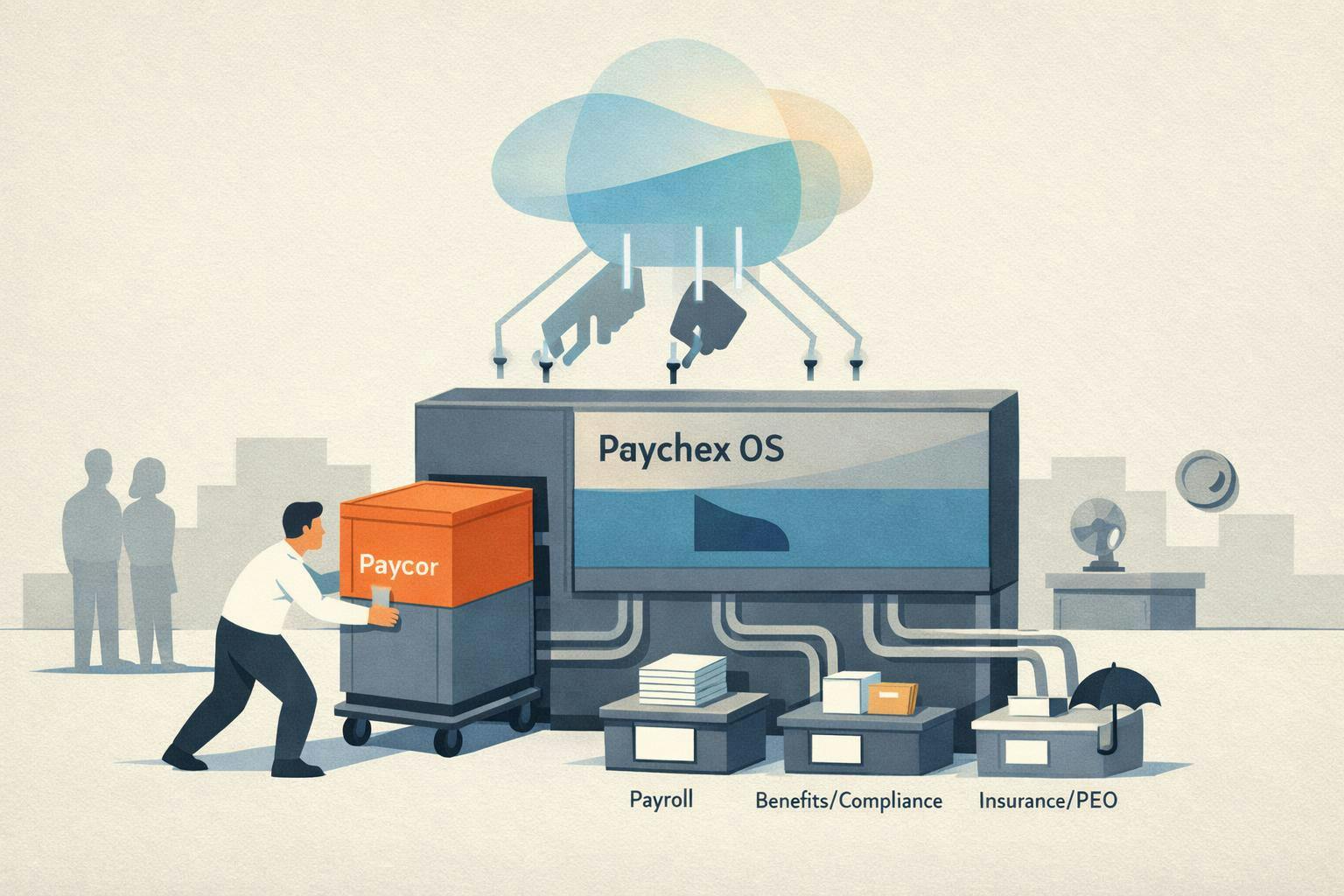
The diversified nature of the business further stabilizes the Paychex PEO and insurance unit revenue outlook. As small and medium-sized businesses (SMBs) face increasing regulatory pressure, they are leaning more heavily on Professional Employer Organization (PEO) models to mitigate risk. This shift ensures that even if hiring slows, the revenue generated per client remains high due to the high-touch nature of compliance services.
The Paychex AI Roadmap: Driving Efficiency for 2026
The long-term investment case for Paychex is increasingly tied to its technological evolution. The company is no longer positioning itself as a mere payroll processor but rather as a provider of a deep operating system for Human Capital Management. This transition is centered on the Paychex AI roadmap, which seeks to transform traditional HR workflows from reactive reporting to proactive automation.
The core of this strategy involves the deployment of proactive AI agents. Unlike traditional software that requires manual input and oversight, these agents are designed to anticipate needs, such as identifying payroll discrepancies before they occur or suggesting shifts in benefits packages based on demographic trends within a client's workforce. This Paychex AI roadmap for human capital management is expected to drive long-term revenue growth by:
- Enhancing Workflow Automation: Reducing the manual labor required by SMB owners, thereby increasing the stickiness of the platform.
- Improving Client Retention: By embedding AI into every facet of the HR lifecycle, Paychex makes it more difficult (and costly) for clients to switch to competitors.
- Supporting Pricing Power: High-value AI advisory services allow for a premium pricing model that is less sensitive to Labor Market Fluctuations.
- Data Monetization: Utilizing the vast datasets acquired through the Paycor merger to train models that offer predictive insights into turnover and hiring trends.
As business formation rates stabilize, the ability to extract more value from existing clients becomes paramount. Paychex is betting that AI-led efficiency will maintain its sector-leading Operating Margins even if the broader economy experiences a cool-down. Integrating these tools into the PEO and insurance segments will likely be the next frontier, providing a holistic compliance "moat" that is difficult for smaller, less capitalized fintech startups to replicate.
Valuation and Risks: The Bulls vs. Bears on PAYX
Despite the strong quarterly beat, a healthy skepticism remains among certain institutional circles regarding the Paychex valuation premium and organic growth risks. Paychex historically trades at a premium—often 40% higher than the equal-weight S&P 500—which places a high burden of proof on management to maintain double-digit growth.
The primary debate centers on Paychex fiscal 2026 revenue growth vs organic growth projections. While total revenue is buoyed by acquisitions, some analysts have actually revised their full-year revenue estimates downward slightly to 6.47 billion, expressing concern that the core organic engine may be sensitive to a softening labor market. Investors must weigh the following factors:
- SMB Business Health: Small businesses are the backbone of Paychex. While current sentiment is stable, a tightening credit environment or sustained inflation could dampen Business Formation Rates.
- Labor Market Fluctuations: Paychex benefits from higher headcounts within its client base. A shift from "hiring mode" to "retention mode" among SMBs could slow the growth of Management Solutions revenue.
- Regulatory Moat: Compliance remains Paychex’s greatest strength. Complex laws like NYC Local Law 144 (regarding AI in hiring) and new payroll transparency mandates in states like Illinois and Maryland force businesses to seek professional help, securing Paychex's role as an essential service provider.
While the valuation is high, the company’s history of consistent earnings beats suggests that management has a high degree of visibility into its revenue streams. The decision to reiterate the fiscal 2026 guidance—projecting revenue growth between 16.5% and 18.5%—indicates internal confidence that the AI roadmap and Paycor synergies will offset any macro-economic headwinds.
Market Context: Analyst Targets and Technical Signals
To understand the broader institutional investor sentiment, we must look at the divergence in Paychex 2026 analyst price targets and ratings. While the fundamental story is one of growth and technological leap-frogging, the stock’s price action remains in a delicate balance.
| Metric | Current Estimate/Signal | 2026 Target/Note |
|---|---|---|
| Mean Price Target | 124.50 | 128.00 |
| High Price Target | 135.00 | 142.00 |
| Low Price Target | 110.00 | 115.00 |
| Current Rating | Hold | Majority Consensus |
| Relative Strength (RSI) | 54.52 | Neutral Zone |
| MACD | Buy Signal | Short-term Momentum |
Technically, the stock is showing resilience. An RSI of 54.52 suggests the stock is neither overbought nor oversold, providing a "neutral" entry point for long-term investors. Furthermore, the MACD has recently flashed a buy signal, suggesting that the market is finally beginning to price in the success of the Paycor integration.
When compared to its primary rival, ADP, Paychex often displays higher volatility but also higher potential for margin expansion through its aggressive AI pivot. While ADP is the "safe" legacy play, Paychex is positioning itself as the "growth" play within the Human Capital Management sector. Investors seeking exposure to the SMB recovery and the automation of professional services will likely find the Paychex stock outlook more compelling, provided they can tolerate the current valuation premium.
In summary, Paychex is a company in transition. It is moving from being a service-heavy payroll firm to a technology-first HR operating system. The 20% growth seen in Q3 is a testament to this strategy. For the patient investor, the integration of data-driven AI and the expanded scale from Paycor represent a solid foundation for the 2026 fiscal year and beyond.
FAQ
Is Paychex a good stock to buy right now?
Paychex is generally considered a strong selection for dividend-growth investors and those seeking defensive exposure to the SMB sector. However, because it currently trades at a valuation premium, many analysts maintain a hold rating, suggesting that investors look for pullbacks or "buy the dip" opportunities rather than entering at all-time highs. The stock's long-term utility is anchored by its essential role in regulatory compliance.
What is the long-term growth forecast for Paychex?
The long-term forecast is heavily dependent on the success of its AI initiatives and its ability to maintain double-digit EPS growth. For fiscal 2026, the company expects revenue growth between 16.5% and 18.5%. Beyond 2026, the shift toward proactive AI agents and automated HR outcomes is expected to sustain operating margins and potentially drive higher revenue per client as manual processes are replaced by high-value software tools.
Is Paychex stock considered overvalued or undervalued?
By traditional metrics, Paychex is often viewed as being at a premium valuation, frequently trading at a 40% higher P/E ratio than the broader market. Whether it is "overvalued" depends on one's view of its moat. Supporters argue the premium is justified by the company's high client retention and its role as a necessary compliance partner for SMBs, while critics point to slower organic growth as a sign that the price may be ahead of the fundamentals.
How does Paychex stock compare to ADP for investors?
Paychex and ADP are the titans of the payroll industry, but they offer different risk profiles. ADP is a larger, more stable global entity that often appeals to conservative institutional investors. Paychex has a sharper focus on the U.S. SMB market and has recently been more aggressive with acquisitions and AI integration. Historically, Paychex has offered slightly higher growth potential during periods of robust U.S. business formation.
What factors are affecting Paychex's stock price?
The primary factors affecting the price include interest rate environments (which impact the "float" income Paychex earns on held payroll funds), labor market health, and the success of the Paycor integration. Additionally, regulatory changes at the state and federal levels act as a catalyst; as laws become more complex, more businesses outsource their HR to Paychex, driving revenue growth.