Quick Facts
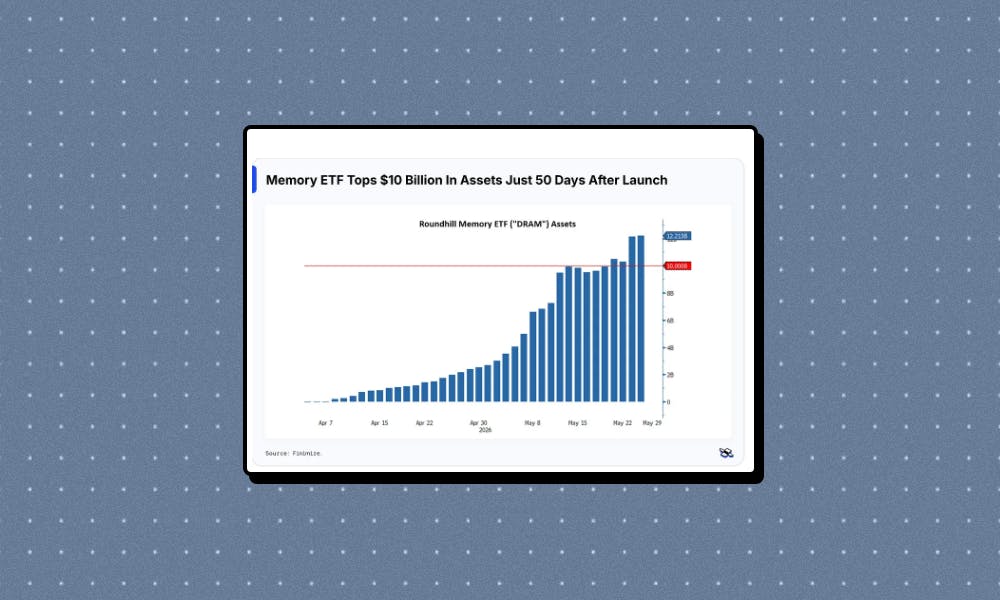
- Record Growth: Reached $10 billion in assets under management within 50 days of launch.
- Cost Structure: Features a 0.65% unitary expense ratio.
- Top Holdings: Highly concentrated with approximately 73% of assets in the Big Three producers.
- Investment Focus: Specifically targets high-bandwidth memory essential for AI infrastructure.
- Growth Driver: Fueled by massive Big Tech capital expenditure in data center expansion.
- Key Components: Includes market leaders like Micron Technology, SK Hynix, and Samsung Electronics.
The Roundhill DRAM ETF (DRAM) has shattered industry records, becoming the fastest-growing fund in history by reaching $10 billion in assets under management in just 50 days. Driven by insatiable AI memory chip demand, this pure-play semiconductor vehicle is the primary tool for investors targeting the high-bandwidth memory (HBM) infrastructure build-out. While the growth is unprecedented, understanding the DRAM ETF concentration and underlying risk management is essential for navigating the current memory supercycle.
The Record-Breaking Rise of DRAM
The launch of the Roundhill DRAM ETF on April 2, 2026, marked a shift in how investors approach the artificial intelligence narrative. For years, the focus remained largely on processing power and GPU manufacturers. However, as AI models grew in complexity, the industry hit a critical wall: memory bandwidth. This shift in market sentiment propelled the fund to reach $1 billion in assets under management in just 10 trading days, a feat that eclipsed the previous speed record held by the iShares Bitcoin Trust.
The momentum did not stop there. By the end of its first month, the fund had amassed $6.5 billion in assets under management within 27 trading days. This velocity is orated by a perfect storm of macroeconomic factors. Large language models (LLMs) require massive amounts of data to be shuttled between storage and processors at lighting speed. This demand has turned memory from a cyclical commodity into a high-tech bottleneck. By May 28, 2026, the fund's assets had climbed to over $12 billion, solidifying its position as the fastest fund to reach the $10 billion milestone, achieving in 50 days what took the previous record-holder 81 days.
Investing in Roundhill DRAM ETF for high-bandwidth memory exposure has become the preferred route for institutional and retail players alike who want to sidestep the broad semiconductor market and focus purely on the supply chain bottleneck. The market recognizes that without advanced memory, the billions spent on GPUs cannot be fully utilized.
Portfolio Strategy: The Pure-Play Advantage
What sets this fund apart from a broad-based index like SOXX or SMH is its strict adherence to a pure-play methodology. To be included in the fund, a company must derive at least 50% of its revenue from memory-related activities. This rule eliminates the dilution found in other tech ETFs, where memory producers are often overshadowed by software giants or diversified hardware conglomerates.
The strategy results in a heavy DRAM ETF concentration within the global memory triumvirate. Currently, Micron Technology, SK Hynix, and Samsung Electronics Co account for over 70% of the fund’s weight. While this might seem excessive to a traditional diversifier, it reflects the reality of the memory supercycle. These three companies effectively control the global supply of the HBM3e standard, which is the current requirement for high-end AI servers.
By using total return swaps and direct equity holdings, the managers ensure that the fund tracks the sector with precision. As Big Tech capital expenditure continues to rise, these three companies are the primary beneficiaries of the shift to HBM4 and beyond. For an investor, the Roundhill DRAM ETF vs diversified semiconductor funds debate comes down to a choice between broad stability and targeted, high-conviction growth.
Thematic ETF Risk Management: Navigating Volatility
As an editor focusing on portfolio strategy, I must emphasize that record-breaking AUM growth often precedes heightened volatility. While the Roundhill DRAM ETF provides direct exposure to the AI memory boom, it also carries significant sector-specific risk. The very concentration that fuels its rise—placing nearly three-quarters of the fund in three stocks—makes it susceptible to sharp corrections if any of "The Big Three" face production hurdles or geopolitical tensions.
Furthermore, investors must monitor the divergence between different segments of the memory market. While demand for AI hardware is experiencing a vertical climb, the consumer spot prices for PC and mobile DRAM have shown signs of cooling. This "two-speed" market creates a complex environment for thematic ETF risk management. If the AI infrastructure build-out slows before the consumer market recovers, the fund could see significant price pressure.
Another emerging concern is the development of TurboQuant and similar software-based memory compression technologies. These innovations aim to reduce the physical hardware requirement for running large models. While still in early stages, any breakthrough that mitigates the supply chain bottleneck could dampen the long-term demand for physical high-bandwidth memory chips. Managing concentration risk in the Roundhill DRAM ETF involves not just watching the stock prices, but observing these technical shifts in how AI models utilize hardware.
Market Outlook and Price Scenarios (2026-2027)
Looking ahead to the next 18 months, the trajectory of the fund will likely be determined by the transition from HBM3e to the HBM4 standard and the continued pace of data center expansion. Below is an analysis of potential price scenarios based on current fundamental trends.
| Scenario | Target Price Range | Primary Drivers |
|---|---|---|
| Bull Case | $52.00 - $60.00 | HBM contract prices rise 50% year-over-year; supply remains in severe deficit. |
| Base Case | $35.00 - $42.00 | Data center expansion continues as projected; steady transition to new HBM standards. |
| Bear Case | $24.00 - $28.00 | Macroeconomic downturn; rapid adoption of software-based memory compression. |
For those wondering if it is too late to buy Roundhill DRAM ETF after launch surge, the answer lies in your time horizon. Short-term technical indicators suggest the fund may enter a consolidation phase after its rapid ascent. However, long-term support levels appear strong around the $32 mark. Identifying these Roundhill DRAM ETF price support levels and buy signals is critical for investors looking to initiate or add to a position during the inevitable market pullbacks.
The growth outlook for the Roundhill DRAM ETF in 2026-2027 remains intrinsically tied to the hardware "land grab" in the AI space. As long as the leading cloud providers continue their aggressive spending, the memory supercycle is likely to persist, even if the pace of ETF asset growth naturally slows from its record-breaking start.
FAQ
What companies are included in the Roundhill DRAM ETF?
The fund is primarily composed of companies that derive at least 50% of their revenue from the memory semiconductor industry. The largest positions are held by the global leaders in memory production: Micron Technology, SK Hynix, and Samsung Electronics. These three companies make up roughly 73% of the fund's total assets.
What is the expense ratio for the Roundhill DRAM ETF?
The fund carries an expense ratio of 0.65%. This is a unitary fee, meaning it covers all operating expenses of the fund, which is relatively standard for specialized, actively managed thematic ETFs in the technology sector.
How is the Roundhill DRAM ETF different from other semiconductor ETFs?
Unlike broad semiconductor ETFs like SOXX or SMH, which include a wide array of chip designers, equipment makers, and foundries, the DRAM ETF focuses exclusively on memory. It uses a strict revenue-threshold rule to ensure that the performance is tied specifically to the memory chip market rather than the broader tech industry.
Is the Roundhill DRAM ETF a good investment for AI growth?
For investors who believe that memory is the primary constraint in AI scaling, the fund offers the most direct exposure available. It captures the upside of the shift toward high-bandwidth memory required for training and deploying large-scale AI models. However, its performance is highly dependent on the "Big Three" producers.
What are the risks of investing in a memory-focused semiconductor ETF?
The primary risks include high concentration (over 70% in three stocks), the cyclical nature of the memory market, and geopolitical risks associated with manufacturing hubs in South Korea and Taiwan. Additionally, thematic funds often experience significant volatility after an initial period of rapid growth and hype.
The Roundhill DRAM ETF has undeniably changed the landscape for thematic investing by proving how quickly capital can move when a critical infrastructure bottleneck is identified. For the long-term investor, the fund represents a high-conviction bet on the physical reality of the AI revolution. As we move deeper into the memory supercycle, the key to success will be balancing the excitement of this record-breaking growth with a disciplined approach to risk and position sizing. Managers and investors alike should continue to monitor the balance between AI demand and consumer market supply to navigate the next phase of this historic fund's journey.